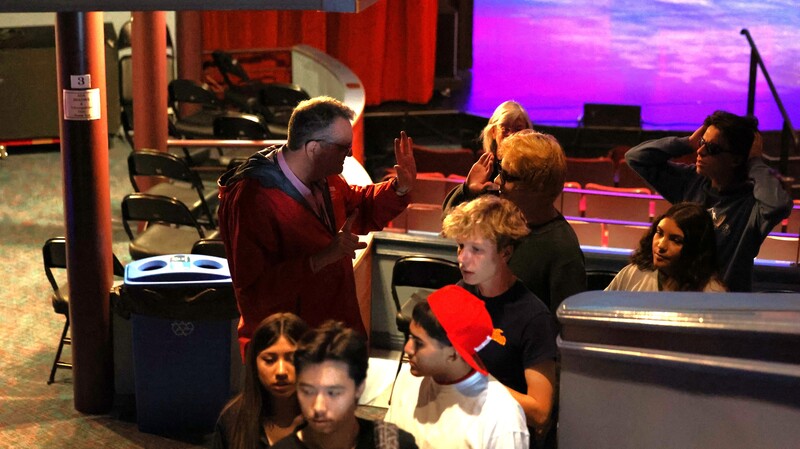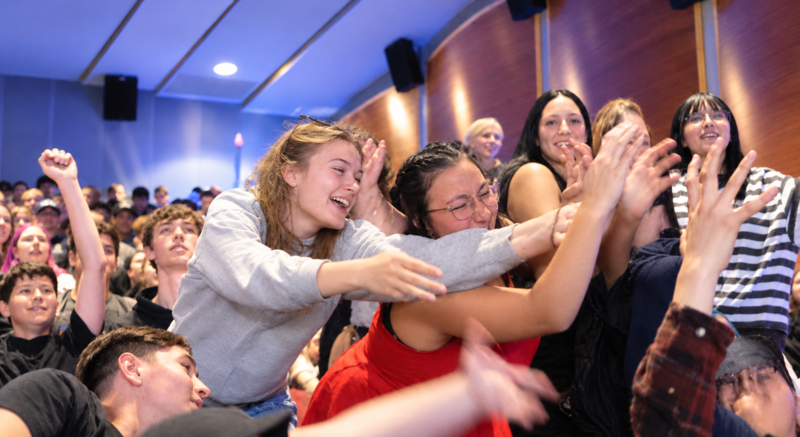
For local high school seniors, graduation may still seem months away, but speakers at this year's Herald and News's Klamath Promise Graduation Motivation event encouraged students to begin thinking now about what comes next and, perhaps most importantly, to make it to the finish line.
Click Here to be directed to the KFCS Facebook To See A Full Photo Gallery
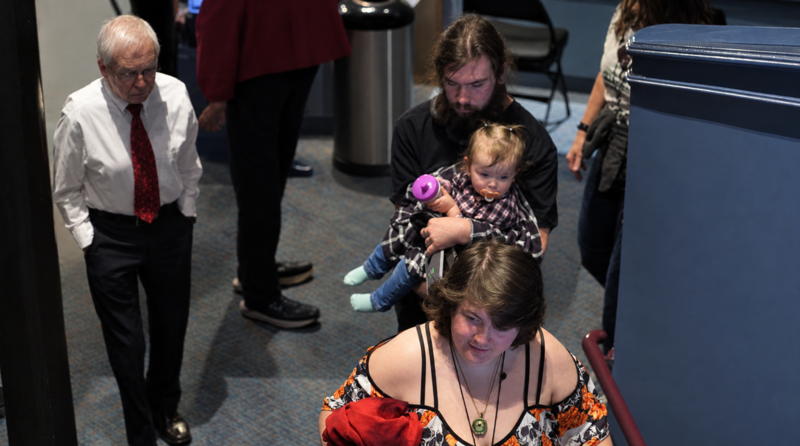
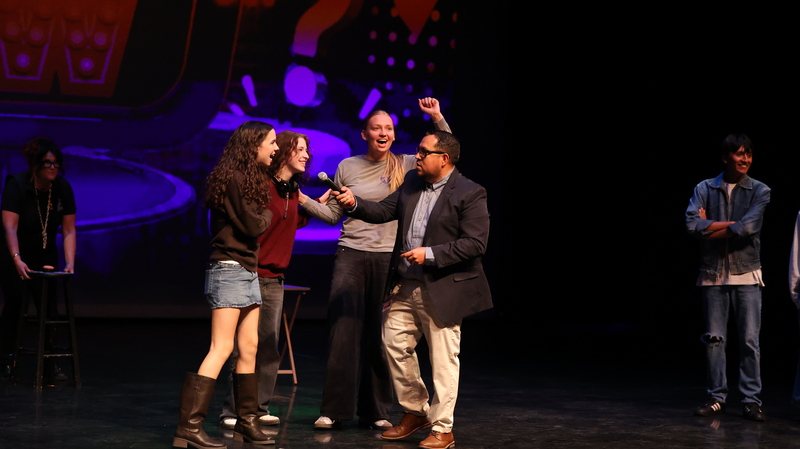
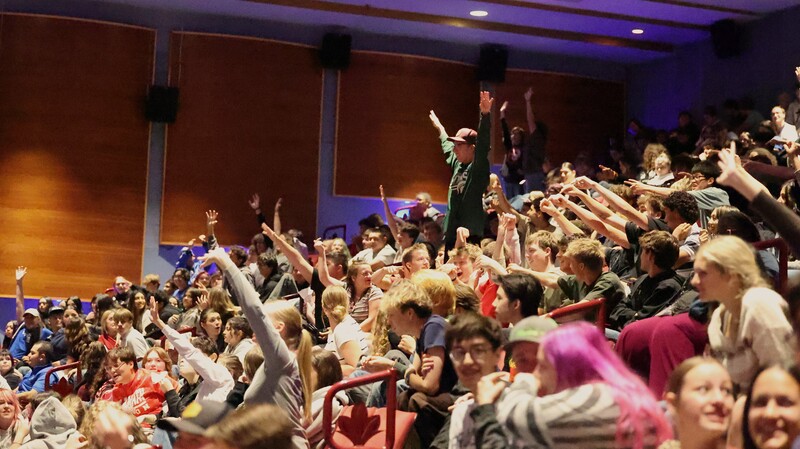
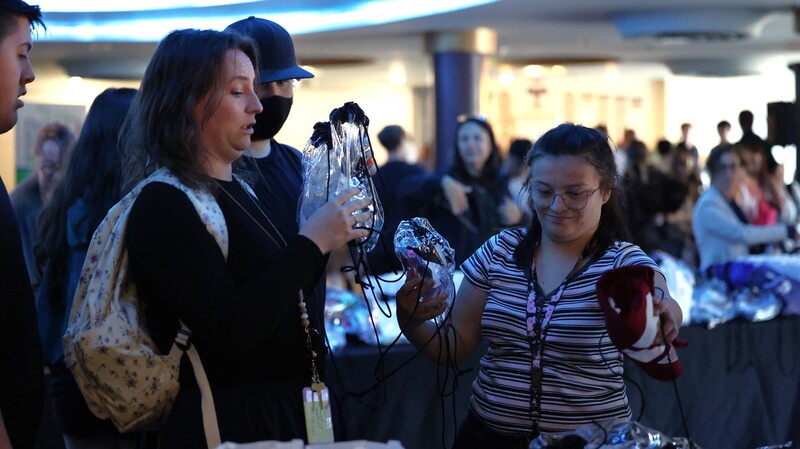
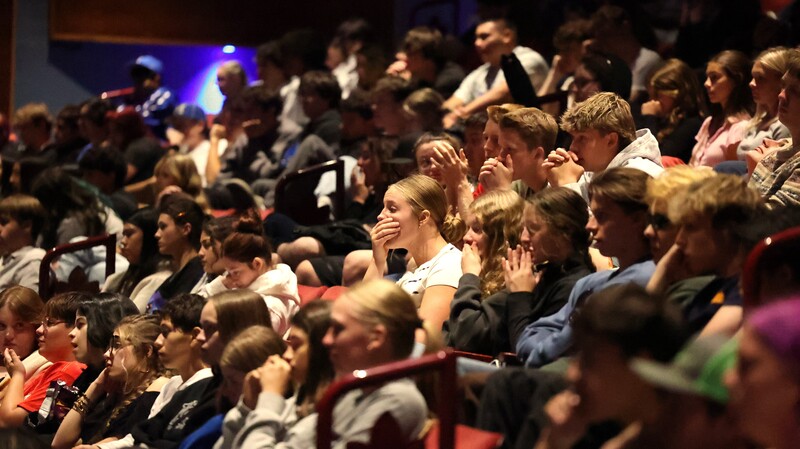
Held at the Ross Ragland Theater, Graduation Motivation brought together local educators, community organizations, higher education representatives, military recruiters and business leaders to encourage students to finish their senior year strong while considering the opportunities available to them after graduation.
Josephine Ness, executive director of admissions and advising at Oregon Tech, opened the event by describing senior year as an important turning point.
“You all are standing on a precipice, and you're looking out at a sea of possibility,” Ness told students. “And for the first time in your life, you get to choose which direction you go in.”
Ness encouraged students to approach those decisions with purpose rather than relying on assumptions or what they may have heard from others.
“I want you to do that with intentionality, with purpose,” she said. “You owe it to yourself. You deserve to choose what's next with intention.”
She compared the process of figuring out life after high school to standing on an Oregon Coast cliff on a foggy day. Students may not yet be able to see exactly where they are headed, she said, but they can spend the next several months clearing away that uncertainty through research and conversations.
“I want you, over the next 10 months, to be standing on that cliff's edge and start to move that fog away so that you can see the horizon, and you can say, ‘There. That's where I'm going.’”
Ness also encouraged students to research careers, education costs, scholarships and financial aid rather than making decisions based solely on what they have heard.
“Do the work to make an intentional decision,” she said.
Technical Sergeant Marc Hawthorne from the Oregon Air National Guard at the 173rd Fighter Wing, Kingsley Field also spoke with students about opportunities available through Kingsley Field, including education benefits and the ability to remain in the Klamath Falls area while pursuing college or a career.
The presentation emphasized the possibility of combining military service with higher education, with Hawthorne explaining that eligible Air National Guard members can receive education benefits while serving part time.
“The Oregon Air National Guard is a part-time responsibility, and can help you pay for your schooling at the same time,” Hawthorne said. "When you compare it to other universities, you might be spending more than $130,000 for tuition and cost of living."
Klamath Community College Director of Retention and Student Success Oscar Herrera also encouraged students to explore financial aid opportunities, including the Oregon Promise Grant.
As a first-generation college student himself, Herrera said he understands taking the next step after high school can be intimidating.
“As a first-generation student myself, as someone that didn't have no one to guide me to go to college, and I'm standing here in front of all you guys telling me to go to college, it's kind of a scary thing,” he said.
“But at the same time, it's a privilege to be here, and hopefully one of you guys can relate and say, ‘You know what, if you could do it, I could do it.’”
Herrera urged students to apply for grants and scholarships even if they are considering options other than community college.
“You should still fill it out. It does not hurt you,” he said.
Herrera also reminded students that Klamath Community College can remain a resource even if their plans take them elsewhere.
“No matter where you go, we are your community,” Herrera said. “We are here to support you. We are here to be with you through this whole process.”
Community involvement was another theme of the event. Holly Stork, Do Good Gang owner, invited students to become involved in community service, leadership and local projects.
“You are surrounded by true believers,” Stork told students. “All of these people you hear speaking, all of those administrators that are here amongst you and teachers, everybody believes in your infinite, extraordinary potential.”
David Stork, chief legal officer for Lithia Driveway, then challenged students to make one simple commitment during their senior year, which was to thank the people who help them along the way.
“None of us get here alone, right?” David Stork said. “It's a journey where we have a lot of guides, a guideposts, and a small promise that I want you all to make to me individually, because this is close to my heart: sometime this year, thank your bus drivers.”
Stork used examples from athletics and agriculture to reinforce his message that senior year represents the final stretch of a longer journey.
“This year is your harvest,” he told students. “You get to decide the quality of the work, sacrifice that you put in, that your family's put in, that your teachers, guides, colleagues put in.”
He ultimately brought the message back to the event's central challenge.
“Today, you have a choice about how strong you want to finish,” David Stork said.
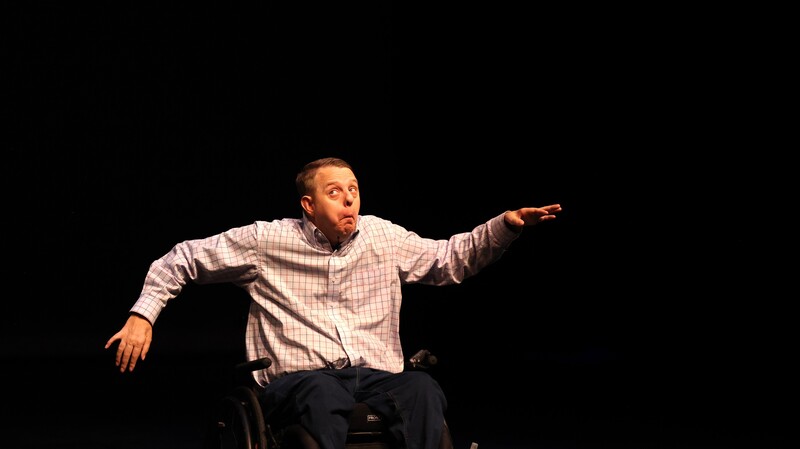
Graduation Motivation's keynote speaker, Jake French, brought a more personal perspective to the event.
For French, the message about making the most of life's opportunities comes from an experience that changed the course of his own life in an instant and would sadly leave him quadriplegic.
French told students that his experience has given him a different perspective on what it means to finish a difficult chapter and move forward.
“One second, I went from on top of the world, college grad, I got my dream job, to laying on that pavement,” French recalled of his accident.
After graduating from the University of Idaho with a degree in Forest Products, French had begun what he considered his dream career as a forester in Oregon. He had been on the job for only three weeks when an evening with friends took a tragic turn.
According to French's account of the accident, he encountered an old childhood friend during the night, and an intoxicated confrontation ended with French being caught in a headlock. When the other person lost his balance and fell forward, French's arms were pinned behind him, leaving him unable to brace his fall.
His head struck the pavement, and the force of the impact broke his neck between the C6 and C7 vertebrae. The injury left him paralyzed from the collarbone down.
That experience became the foundation for French's work as a motivational speaker. Rather than allowing the accident to define the rest of his life, he began focusing on what he could control, his attitude, his choices and the direction he wanted to take next.
“Even though I'm sitting, instead of standing, I still kind of want the same thing,” French said. “I just want to be able to look in that mirror at the end of the day and be like, ‘Man, I really worked hard today. I really gave it my all.’”
French challenged students to think carefully about the decisions they make now, particularly when it comes to choices involving alcohol and drugs. He shared the long-term financial, professional and personal consequences he experienced following a DUI he received shortly before an internship that could have helped launch his forestry career.
His message was not simply about avoiding mistakes, however. French also encouraged students to build a reputation for themselves through involvement, volunteering and taking initiative.
French described this as building a “life résumé,” the experiences and relationships that demonstrate who a person is beyond grades or a traditional résumé.
“If you don't like what people would write about your life résumé right now, you have the power to change it,” French told students.
French also encouraged students to develop a mindset focused on possibilities rather than limitations. He challenged them to recognize three words, “can't,” “won't” and “don't,” as barriers to creative thinking and problem-solving.
Instead, French encouraged students to ask a different question: How could we make this work?
That mindset, he said, can become valuable well beyond high school.
“Employers, people who have businesses, they have problems every single day,” French said. “They want people to solve problems. They want people to think, ‘How can we make this work?’”
Herald and News - Klamath Falls, Ore. Klamath Promise Oregon Tech Klamath Community College (KCC) 173rd Fighter Wing, Kingsley Field 173rd Fighter Wing, Kingsley Field Military and Family Readiness Program Klamath Union High School Eagle Ridge New Tech High School Klamath Learning Center Klamath County School District Southern Oregon Education Service District - SOESD Lithia Toyota of Klamath Falls The Ross Ragland Theater